A Flash game, 2012
Alien Smash: where it all began
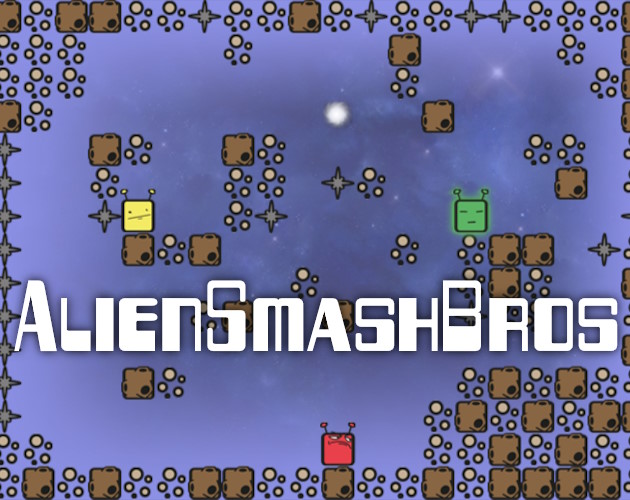
In 2012 I released a small puzzle game about square aliens on Newgrounds. It became my first online game, my first sponsorship and the start of my career as a Flash game developer.
At a glance
- First release
- September 15, 2012
- Original
- Adobe Flash
- Genre
- Sliding puzzle
- Remake
- TypeScript and PixiJS
01 · The first release
A small game, a huge step

Alien Smash was not the most ambitious project I could imagine. It was, however, the first one I took all the way to the decisive step: putting it online and allowing strangers to play it.
Its Newgrounds page still records an exact date: September 15, 2012. I think of that as a small official beginning. Before then I had experiments, files on my computer and ideas. From that day on, I had a public game.
02 · The game
Square aliens that cannot stop
The idea came from ice and sliding-crate puzzles. At the time I mentioned The Legend of Zelda: Twilight Princess and Goof Troop on the Super Nintendo as references. Once launched, an alien kept moving until something stopped it. Solving a room meant reading its space, predicting a path and using obstacles.
In the original version, clicking one side of a creature launched it in the opposite direction. A level ended when every star had been reached. The rule was easy to explain but rich enough to produce compact mazes.
Looking back, I can already see interests that would return in later work: space as a system of rules, mechanics explained through movement, and simple characters that only need a pair of eyes and a little animation to feel alive.
03 · Newgrounds
Publishing in the age of Flash portals
Newgrounds was a showcase, an arcade and a community at once. Uploading a Flash file placed a game immediately in a public space of votes, reviews and rankings. There was no need to build a personal website or persuade anyone to install it: players only had to open a page in their browser.
That made publishing accessible, but also very direct. A finished project could be judged within minutes beside hundreds of others. I quickly learned that completing a game and presenting it are two different skills, and that both matter.
Alien Smash did not become a phenomenon. It gave me something more useful: proof that I could finish a project, distribute it and receive a response from real players. It was the concrete beginning of my career as a Flash game developer.
04 · The first earnings
When a hobby became paid work for the first time
Flash games existed inside an economy that has now almost disappeared. Portals constantly looked for new titles to attract visitors, while developers offered sponsorships, customized builds and licenses restricted to a specific website.
FGL, then known as Flash Game License, connected those two groups. Developers uploaded games; publishers reviewed them and could make an offer. A non-exclusive license gave a portal its own version without preventing the creator from distributing the game elsewhere.
Alien Smash received one of those non-exclusive sponsorships. It was not a large amount, and the amount is not what matters in this memory. It was the first time someone chose to pay me for a game I had worked on. That transaction turned an abstract possibility into something real.
It did not mean I had found a stable business model. It meant that making games could also be a profession. For a first project, that confirmation was enormous.
05 · A vanished ecosystem
The speed and fragility of the Flash Web
Flash made it possible to move quickly from an idea to a file that could run almost anywhere. That lightness encouraged short games, experimentation and rapid development cycles. Portals supplied an audience; advertising, licenses and sponsorships tried to support the people making the content.
The system was also tied to one technology and a network of intermediaries. As Flash declined, sponsorship opportunities shrank and many portals changed or disappeared. Alien Smash’s old page survived, but the way the game was built and distributed belongs to a different era of the Web.
06 · The rewrite
Returning in 2024 without pretending it was still 2012
More than a decade later, nostalgia brought me back to Alien Smash. I did not want to recover the old Flash file or make a museum replica. I rewrote the game in TypeScript using PixiJS and contemporary browser technology.
The core stayed the same. Aliens slide until they meet an obstacle, and each level asks the player to steer them toward the nova. The remake adds keyboard controls, undo and reset commands, swipe controls on phones, and situations involving several creatures.
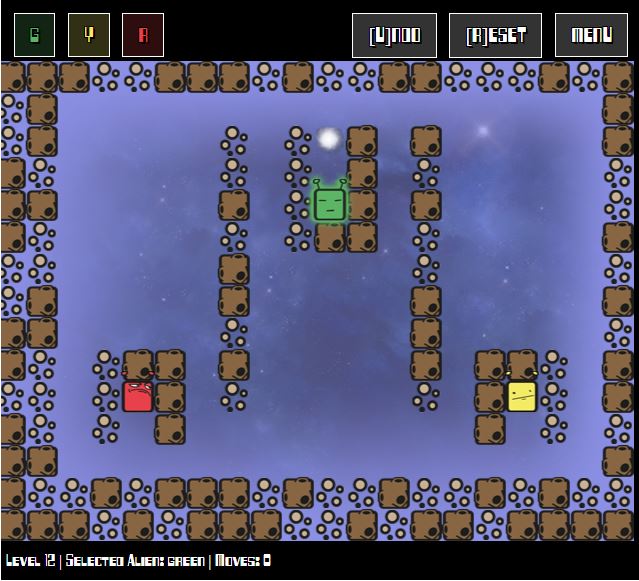
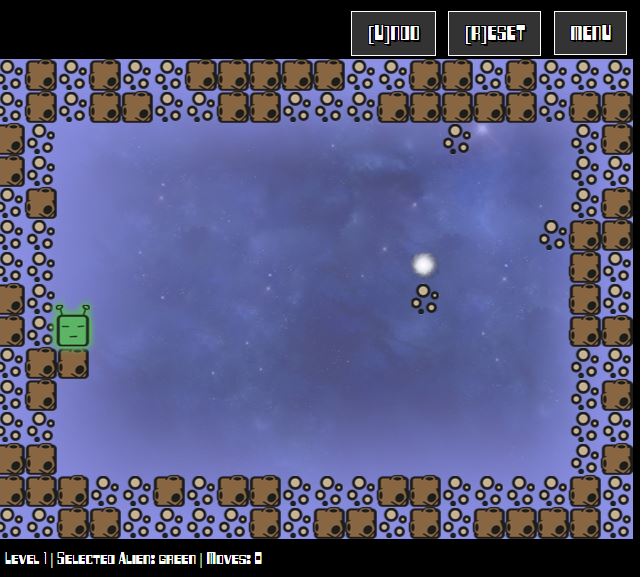
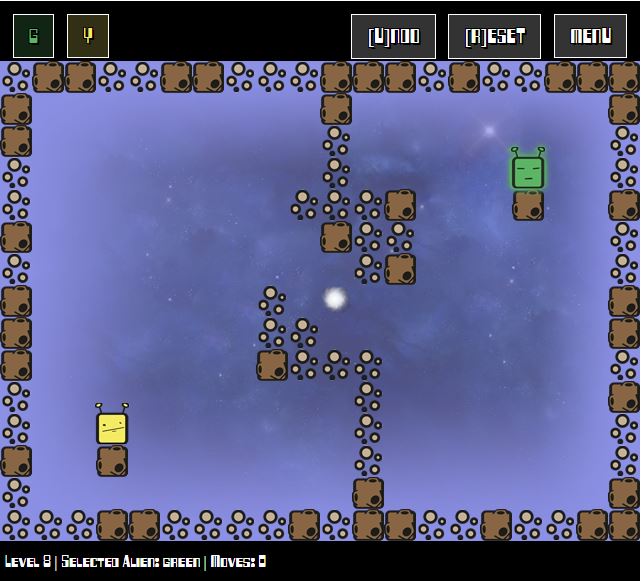
Public screenshots from the HTML5 version on itch.io.
Rewriting it let me measure the distance I had travelled. The code was new and the controls suited current devices, but underneath was the same small idea with which I had started.
07 · What stayed with me
A first game does not have to be the perfect game
Had I waited until I felt capable of publishing something bigger and more polished, I probably would not have learned the same lessons. Alien Smash taught me that finishing a project changes the relationship with your work: it makes it visible, open to criticism and, sometimes, even sellable.
The sponsorship was small, but its meaning was not. The rewrite does not exist to fix that beginning. It exists to recognize it: my career started with a square alien, a Flash file and the button that published it on Newgrounds.
Public sources and personal memory
Dates, game descriptions and visual material come from public pages. The sponsorship account is a personal recollection; I am not publishing the contract, the amount or other private details.
- Alien Smash on Newgrounds — original date, description, genre and thumbnail.
- Alien Smash Bros on itch.io — playable version, controls, platforms, PixiJS and screenshots.
- Public remake announcement on itch.io — the TypeScript and HTML5 rewrite.
- FGL platform history — its role connecting developers and publishers.
- PocketGamer.biz on FGL’s marketplace — licensing and sponsorship in the Flash ecosystem.
Sources reviewed on July 29, 2026.